
“Imagine how much harder physics would be if electrons had feelings.” – Richard Feynman. Welcome to financial markets.
Only a few months ago the sentiment in the market was that everything was priced in. People believed that investors had already considered all possibilities and thus had already bought or sold according to what is known. Implying that prices were already set at what they should be, leaving no room for advantageous play.
The technical term of what people were referring to is the efficient market theory: That financial markets reflect all available information, making it impossible to consistently achieve returns above the market’s average. This theory was developed in the 1960s and has been taught in universities since then.
I have heard many highly successful investors completely debunk this theory. Andrew Brenton, CEO and co-founder of Turtle Creek Asset Management went so far as to say “[To] conclude the market’s getting it right.. is the greatest economic error in thought in the 20th century.” Warren Buffett has also said that the efficient market theory is false because psychology is not efficient. And psychology is a very large factor in economics[1].
So in 2024, we had a situation where people were leaning towards this delusion of an efficient market theory. Understandably so, because the markets were behaving fairly strangely where bad news was good for equities and the good news was bad for some time while people feared long-term inflation and hoped for a soft landing.
With that, it’s important to keep in mind that good investing, by nature, is contrarian. If you are following others then it has already been priced in, and you’re too late. No one hands out free money, so why do you think someone will give you a free investment decision? And don’t tell me they charge money for it either. If they truly have the best investment decisions, they’ll do what the best do and borrow cheap money to invest as much as possible in their decisions and profit from it without needing to deal with others.
“The most contrarian thing of all is not to oppose the crowd but to think for yourself.” – Peter Thiel
There’s a saying in investing that helps remain contrarian “believe nothing you hear and only half of what you see.” Believe nothing you hear because a good investment must either be an original thought, or you must at least be early to the game. Anyone can conclude an original thought using wisdom and quality information. But to be early to the game for some other reason is usually only reserved for the elite or privileged who have exclusive connections or who can afford access to that information. So most likely, you’re going to have to conclude an original thought.
Then, only believe half of what you see because Ponzi schemes and market mania exist. If you’re in a ponzi/fraud scheme or a market mania, you could be earning real money in your bank account. Seeing is believing they say, and your eyes are not deceiving you. Nothing is more real than real cash in your account. Until suddenly, you lose everything when the fraud implodes or the market corrects. So you must be cautious even of what you see.
In February, I wrote an essay about Market Forces. It’s a must-read on investing. I explained why prices move, what price dislocation is, and how to invest as a layman. To validate what I was demonstrating, I used a working example of a stock to buy. That stock was Tesla. I articulated precisely why Tesla stock was down, who was selling and why, and why it’s a good opportunity to buy for the long term.
Shortly after I wrote that, Tesla continued its decline as mainstream media even questioned its ability to recover. CNBC wrote “Tesla’s awful quarter has Wall Street on edge ahead of delivery numbers” and “Tesla shares have tanked 34% this year. Investors raise doubts over whether the EV maker will return to form“!
This didn’t phase me at all. Rather, I continued to increase my holdings. As I wrote in that essay, “Since nobody can time the market, and I’m unlikely to outsmart big finance, a good buy-in strategy is to dollar cost average into TSLA during this downturn since I don’t know how long these struggles will last.” So I continued to buy over a period of months, knowing that the price could continue far lower before it recovers.
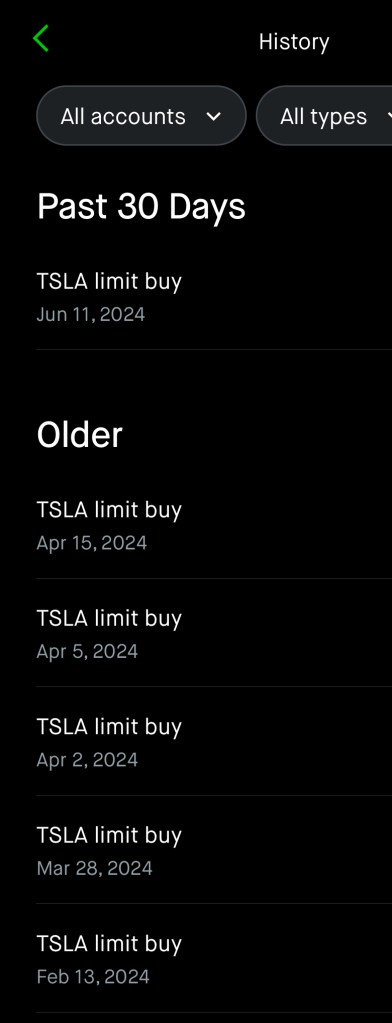
Keep in mind that there was a possibility of Tesla failing. My estimations for this happening were very low, but still a possibility nonetheless. That unknown is called risk, and it’s the only reason I didn’t take out a loan with all my personal assets as collateral to invest in it.
This is a key point to reiterate; keep your emotions out of investing. Had I discovered information that led me to believe that Telsa was no longer positioned for success, I would’ve sold and taken my losses.
But also be careful not to panic sell due to an elaborate tweet or even if everyone is saying you’ll lose your shirt. Believe nothing you hear and only half of what you see. It’s a temperament that not everyone can achieve with real money on the line.
The price of Tesla at the time I published that essay was $191.97 and as of publishing this today is $350.00, an 82.32% gain.
Let’s address the elephant in the room, the market is currently in a euphoric state. Excitement is high, investing is a popular topic of discussion and it’s easy to feel like a good investor because prices are high. I’m not immune to these side effects of a euphoric market, but I’m aware of it and try my best to remain grounded and robotic in my decision-making. Emotions will kill you in investing if you let your guard down.
The broad market is up in large part due to the US presidential election. Uncertainty triggers more fear in investors and markets than bad news. Donald Trump on paper is not the greatest option as president for the economy. But with the conclusion of elections, that certainty of who will be the next president, whether good or bad, adds great comfort to the market.
That aside, Trump is expected to be beneficial for some companies and industries. Crypto is one of them. He plans to remove some regulatory hurdles and add support to the industry which explains Bitcoin’s recent all-time highs. Granted, Bitcoin would’ve reached those prices eventually with or without him, Trump still is a plus for Crypto as reflected in the massive short-term inflows.
When I predicted Tesla stock as a buy in the Market Forces essay, Elon was still undecided on who he was voting for president in 2024. So Trump’s effect on Tesla is a stroke of luck in my case. Elon’s companies, which have struggled with governmental cooperation and regulation, are expected to offload a ton of weight holding them down and launch to space, literally and figuratively. The odds of Tesla’s big bet on autonomy just increased and Space X seemingly will have less trouble increasing its volume of launches and innovation. If Space X was a public company, I presume its stock would be up a massive amount right now with these new factors in consideration.
Presidential election aside, Tesla was/is still very well positioned in a nascent, growing, high-potential industry, with an impressive team and strong fanbase. It may have taken longer to reach this price without the election, but with the information I had, it was going to end up here one way or another.
Another strong bet I made during this time was Coinbase. A proxy for the crypto industry as a whole. In April I wrote an essay explaining my long-term commitment to crypto, and why I believed in it. Coinbase was still recovering from the industry’s biggest struggles yet, and I made a series of shorter-term options trades on its way up. Coinbase then began to stagnate in August alongside Bitcoin and I saw an opportunity. Since I was unsure of how long it would take to recover, I borrowed money to buy and hold as many shares as I could, loading up over time to mitigate risk. It’s now up 58% from my average purchase price or net ~48% after interest & fees.
Coinbase is another stock I have long-term conviction in but am very cautious about any fatal concealed malpractice that centralized crypto companies tend to partake in. The stock also tends to be very volatile swinging between undervalued and overvalued leaving room for occasional trading.
Much of long-term investing consists of sitting around and not having much action for months or sometimes even years. This was my case for a couple of months—as expected. Nothing exciting in the news and not much movement in price at all. Bland, as good investing should be. But then, if everything goes according to plan, there are periodic explosive movements or long bull runs where the price starts to match value.
“The big money is not in the buying or selling, but in the waiting” – Charlie Munger
“The stock market is a device for transferring money from the impatient to the patient.” – Warren Buffett
There’s a saying that the most successful investors are dead people. They have an uncanny ability to do nothing, no buying or selling. There is a lot of truth to this. Many studies show that time in the market often beats timing the market, thanks to the power of compound interest and avoiding emotional mistakes and the unpredictability of the market.
There’s this insightful story about a fictional character named Bob who began regularly investing in the S&P 500 in 1970 at age 22 until he retired at the end of 2013. Bob never sold a single share, however, he is the world’s worst market timer. Every time he bought was during a market peak, right before a crash.
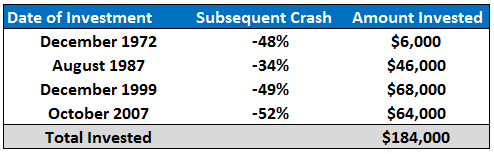
He invested a total of $184,000 yet still ended up a millionaire with $1.1 million, a pretty large sum. Had he simply dollar cost averaged into the market on an annual basis with his savings, he would have ended up with much more money—over $2.3 million. Be very careful trying to time the market, and trust the power of time in the market. If Warren Buffett can’t time the market, yet is still wildly successful, maybe you and I as a layman need not try it.
Perhaps the single most important trait an investor can have is the ability to buy when prices are down and when everyone is panicking, and be scared and extra cautious when prices are skyrocketing and everyone’s making money. It’s extremely simple to understand and seems simple to do, but is actually extremely difficult because it’s counterintuitive and goes against human nature.
The market is currently euphoric. When you start hearing friends and family who never talk finance suddenly talk about sky-high prices, that’s an indication. Tread the waters carefully.
[1]There are theories that the markets have been getting more and more inefficient. Fundamental value-investing is a less effective strategy, and “cultural hype”, new to this century thanks to social media and decentralized media, has played a larger effect on price movement (meme stocks, GME, AMC, DJT, etc.).

